# PhiFlow
**Repository Path**: sithphil/PhiFlow
## Basic Information
- **Project Name**: PhiFlow
- **Description**: 可微分的偏微分方程求解框架
- **Primary Language**: Python
- **License**: MIT
- **Default Branch**: master
- **Homepage**: https://github.com/tum-pbs/PhiFlow
- **GVP Project**: No
## Statistics
- **Stars**: 0
- **Forks**: 2
- **Created**: 2023-03-11
- **Last Updated**: 2023-03-11
## Categories & Tags
**Categories**: Uncategorized
**Tags**: None
## README
# 

[](https://pypi.org/project/phiflow/)
[](https://pypi.org/project/phiflow/)
[](https://codecov.io/gh/tum-pbs/PhiFlow/branch/develop/)
[](https://colab.research.google.com/github/tum-pbs/PhiFlow/blob/develop/docs/Fluids_Tutorial.ipynb)
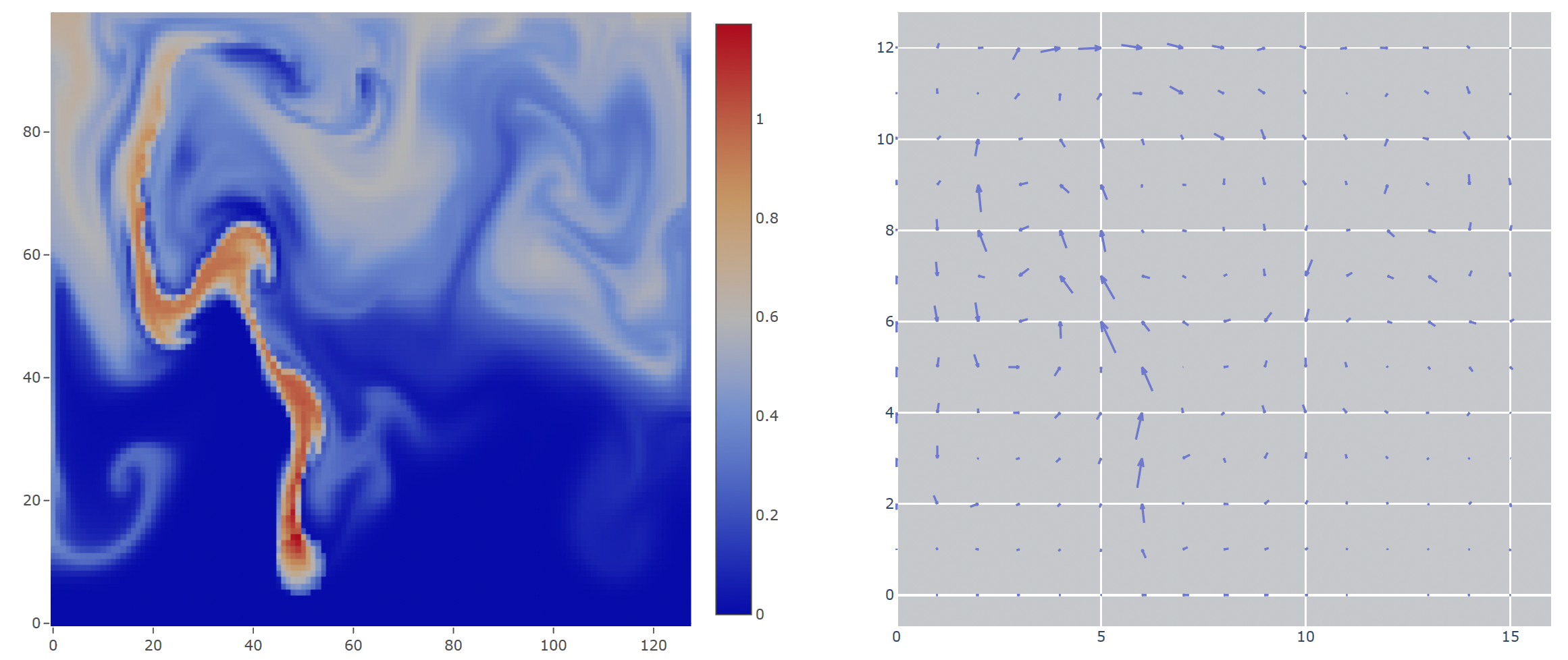
ΦFlow is an open-source simulation toolkit built for optimization and machine learning applications.
It is written mostly in Python and can be used with
[NumPy](https://numpy.org/),
[PyTorch](https://pytorch.org/),
[Jax](https://github.com/google/jax)
or [TensorFlow](https://www.tensorflow.org/).
The close integration with these machine learning frameworks allows it to leverage their automatic differentiation functionality,
making it easy to build end-to-end differentiable functions involving both learning models and physics simulations.
[//]: # ()
|  |
|  |
|------------------|---------------------------------------------------------------------------------------------------------------------------------------------------------------------------------------------------------------------------------------------------------------------------------------------------------------|
| [Fluids Tutorial](https://tum-pbs.github.io/PhiFlow/Fluids_Tutorial.html) • [ΦFlow to Blender](https://github.com/intergalactic-mammoth/phiflow2blender) | [Animation Gallery](https://tum-pbs.github.io/PhiFlow/Animations.html) • [Solar System](https://tum-pbs.github.io/PhiFlow/Planets_Tutorial.html) • [Learning to Throw](https://tum-pbs.github.io/PhiFlow/Learn_to_Throw_Tutorial.html) |
## Features
* Variety of built-in PDE operations with focus on fluid phenomena, allowing for concise formulation of simulations.
* Tight integration with PyTorch, Jax and TensorFlow for straightforward neural network training with fully differentiable simulations that can [run on the GPU](https://tum-pbs.github.io/PhiFlow/GPU_Execution.html#enabling-gpu-execution).
* Flexible, easy-to-use [web interface](https://tum-pbs.github.io/PhiFlow/Web_Interface.html) featuring live visualizations and interactive controls that can affect simulations or network training on the fly.
* Object-oriented, vectorized design for expressive code, ease of use, flexibility and extensibility.
* Reusable simulation code, independent of backend and dimensionality, i.e. the exact same code can run a 2D fluid sim using NumPy and a 3D fluid sim on the GPU using TensorFlow or PyTorch.
* High-level linear equation solver with automated sparse matrix generation.
## Installation
Installation with [pip](https://pypi.org/project/pip/) on [Python 3.6](https://www.python.org/downloads/) and above:
``` bash
$ pip install phiflow
```
Install [PyTorch](https://pytorch.org/), [TensorFlow](https://www.tensorflow.org/install) or [Jax](https://github.com/google/jax#installation) in addition to ΦFlow to enable machine learning capabilities and GPU execution.
To enable the web UI, also install [Dash](https://pypi.org/project/dash/).
For optimal GPU performance, you may compile the custom CUDA operators, see the [detailed installation instructions](https://tum-pbs.github.io/PhiFlow/Installation_Instructions.html).
You can verify your installation by running
```bash
$ python3 -c "import phi; phi.verify()"
```
This will check for compatible PyTorch, Jax and TensorFlow installations as well.
## Documentation and Tutorials
[**Documentation Overview**](https://tum-pbs.github.io/PhiFlow/)
• [**▶ YouTube Tutorials**](https://www.youtube.com/playlist?list=PLYLhRkuWBmZ5R6hYzusA2JBIUPFEE755O)
• [**API**](https://tum-pbs.github.io/PhiFlow/phi/)
• [**Demos**](https://github.com/tum-pbs/PhiFlow/tree/master/demos)
• [
|
|------------------|---------------------------------------------------------------------------------------------------------------------------------------------------------------------------------------------------------------------------------------------------------------------------------------------------------------|
| [Fluids Tutorial](https://tum-pbs.github.io/PhiFlow/Fluids_Tutorial.html) • [ΦFlow to Blender](https://github.com/intergalactic-mammoth/phiflow2blender) | [Animation Gallery](https://tum-pbs.github.io/PhiFlow/Animations.html) • [Solar System](https://tum-pbs.github.io/PhiFlow/Planets_Tutorial.html) • [Learning to Throw](https://tum-pbs.github.io/PhiFlow/Learn_to_Throw_Tutorial.html) |
## Features
* Variety of built-in PDE operations with focus on fluid phenomena, allowing for concise formulation of simulations.
* Tight integration with PyTorch, Jax and TensorFlow for straightforward neural network training with fully differentiable simulations that can [run on the GPU](https://tum-pbs.github.io/PhiFlow/GPU_Execution.html#enabling-gpu-execution).
* Flexible, easy-to-use [web interface](https://tum-pbs.github.io/PhiFlow/Web_Interface.html) featuring live visualizations and interactive controls that can affect simulations or network training on the fly.
* Object-oriented, vectorized design for expressive code, ease of use, flexibility and extensibility.
* Reusable simulation code, independent of backend and dimensionality, i.e. the exact same code can run a 2D fluid sim using NumPy and a 3D fluid sim on the GPU using TensorFlow or PyTorch.
* High-level linear equation solver with automated sparse matrix generation.
## Installation
Installation with [pip](https://pypi.org/project/pip/) on [Python 3.6](https://www.python.org/downloads/) and above:
``` bash
$ pip install phiflow
```
Install [PyTorch](https://pytorch.org/), [TensorFlow](https://www.tensorflow.org/install) or [Jax](https://github.com/google/jax#installation) in addition to ΦFlow to enable machine learning capabilities and GPU execution.
To enable the web UI, also install [Dash](https://pypi.org/project/dash/).
For optimal GPU performance, you may compile the custom CUDA operators, see the [detailed installation instructions](https://tum-pbs.github.io/PhiFlow/Installation_Instructions.html).
You can verify your installation by running
```bash
$ python3 -c "import phi; phi.verify()"
```
This will check for compatible PyTorch, Jax and TensorFlow installations as well.
## Documentation and Tutorials
[**Documentation Overview**](https://tum-pbs.github.io/PhiFlow/)
• [**▶ YouTube Tutorials**](https://www.youtube.com/playlist?list=PLYLhRkuWBmZ5R6hYzusA2JBIUPFEE755O)
• [**API**](https://tum-pbs.github.io/PhiFlow/phi/)
• [**Demos**](https://github.com/tum-pbs/PhiFlow/tree/master/demos)
• [ **Playground**](https://colab.research.google.com/drive/1zBlQbmNguRt-Vt332YvdTqlV4DBcus2S#offline=true&sandboxMode=true)
To get started, check out our YouTube tutorial series and the following Jupyter notebooks:
* [](https://colab.research.google.com/github/tum-pbs/PhiFlow/blob/develop/docs/Math_Introduction.ipynb) [Tensors](https://tum-pbs.github.io/PhiFlow/Math_Introduction.html): Introduction to tensors.
* [](https://colab.research.google.com/github/tum-pbs/PhiFlow/blob/develop/docs/Fluids_Tutorial.ipynb) [Fluids](https://tum-pbs.github.io/PhiFlow/Fluids_Tutorial.html): Introduction to core classes and fluid-related functions.
* [](https://colab.research.google.com/github/tum-pbs/PhiFlow/blob/develop/docs/Planets_Tutorial.ipynb) [Solar System](https://tum-pbs.github.io/PhiFlow/Planets_Tutorial.html): Visualize a many-body system with Newtonian gravity.
* [](https://colab.research.google.com/github/tum-pbs/PhiFlow/blob/develop/docs/Learn_to_Throw_Tutorial.ipynb) [Learn to Throw](https://tum-pbs.github.io/PhiFlow/Learn_to_Throw_Tutorial.html): Train a neural network to hit a target, comparing supervised and differentiable physics losses.
If you like to work with an IDE, like PyCharm or VS Code, the following demos will also be helpful:
* [smoke_plume.py](demos/smoke_plume.py) runs a smoke simulation and displays it in the web interface.
* [optimize_pressure.py](demos/differentiate_pressure.py) uses TensorFlow to optimize a velocity field and displays it in the web interface.
## Publications
We will upload a whitepaper, soon.
In the meantime, please cite the ICLR 2020 paper.
* [Learning to Control PDEs with Differentiable Physics](https://ge.in.tum.de/publications/2020-iclr-holl/), *Philipp Holl, Vladlen Koltun, Nils Thuerey*, ICLR 2020.
* [Solver-in-the-Loop: Learning from Differentiable Physics to Interact with Iterative PDE-Solvers](https://arxiv.org/abs/2007.00016), *Kiwon Um, Raymond Fei, Philipp Holl, Robert Brand, Nils Thuerey*, NeurIPS 2020.
* [ΦFlow: A Differentiable PDE Solving Framework for Deep Learning via Physical Simulations](https://montrealrobotics.ca/diffcvgp/), *Nils Thuerey, Kiwon Um, Philipp Holl*, DiffCVGP workshop at NeurIPS 2020.
* [Physics-based Deep Learning](https://physicsbaseddeeplearning.org/intro.html) (book), *Nils Thuerey, Philipp Holl, Maximilian Mueller, Patrick Schnell, Felix Trost, Kiwon Um*, DiffCVGP workshop at NeurIPS 2020.
* [Half-Inverse Gradients for Physical Deep Learning](https://arxiv.org/abs/2203.10131), *Patrick Schnell, Philipp Holl, Nils Thuerey*, ICLR 2022.
* [Scale-invariant Learning by Physics Inversion](https://arxiv.org/abs/2109.15048), *Philipp Holl, Vladlen Koltun, Nils Thuerey*, NeurIPS 2022.
ΦFlow has been used in the following data sets:
* [PDEBench](https://github.com/pdebench/PDEBench)
* [PDEarena](https://microsoft.github.io/pdearena/)
## Version History
The [Version history](https://github.com/tum-pbs/PhiFlow/releases) lists all major changes since release.
The releases are also listed on [PyPI](https://pypi.org/project/phiflow/).
## Contributions
Contributions are welcome! Check out [this document](CONTRIBUTING.md) for guidelines.
## Acknowledgements
This work is supported by the ERC Starting Grant realFlow (StG-2015-637014) and the Intel Intelligent Systems Lab.
**Playground**](https://colab.research.google.com/drive/1zBlQbmNguRt-Vt332YvdTqlV4DBcus2S#offline=true&sandboxMode=true)
To get started, check out our YouTube tutorial series and the following Jupyter notebooks:
* [](https://colab.research.google.com/github/tum-pbs/PhiFlow/blob/develop/docs/Math_Introduction.ipynb) [Tensors](https://tum-pbs.github.io/PhiFlow/Math_Introduction.html): Introduction to tensors.
* [](https://colab.research.google.com/github/tum-pbs/PhiFlow/blob/develop/docs/Fluids_Tutorial.ipynb) [Fluids](https://tum-pbs.github.io/PhiFlow/Fluids_Tutorial.html): Introduction to core classes and fluid-related functions.
* [](https://colab.research.google.com/github/tum-pbs/PhiFlow/blob/develop/docs/Planets_Tutorial.ipynb) [Solar System](https://tum-pbs.github.io/PhiFlow/Planets_Tutorial.html): Visualize a many-body system with Newtonian gravity.
* [](https://colab.research.google.com/github/tum-pbs/PhiFlow/blob/develop/docs/Learn_to_Throw_Tutorial.ipynb) [Learn to Throw](https://tum-pbs.github.io/PhiFlow/Learn_to_Throw_Tutorial.html): Train a neural network to hit a target, comparing supervised and differentiable physics losses.
If you like to work with an IDE, like PyCharm or VS Code, the following demos will also be helpful:
* [smoke_plume.py](demos/smoke_plume.py) runs a smoke simulation and displays it in the web interface.
* [optimize_pressure.py](demos/differentiate_pressure.py) uses TensorFlow to optimize a velocity field and displays it in the web interface.
## Publications
We will upload a whitepaper, soon.
In the meantime, please cite the ICLR 2020 paper.
* [Learning to Control PDEs with Differentiable Physics](https://ge.in.tum.de/publications/2020-iclr-holl/), *Philipp Holl, Vladlen Koltun, Nils Thuerey*, ICLR 2020.
* [Solver-in-the-Loop: Learning from Differentiable Physics to Interact with Iterative PDE-Solvers](https://arxiv.org/abs/2007.00016), *Kiwon Um, Raymond Fei, Philipp Holl, Robert Brand, Nils Thuerey*, NeurIPS 2020.
* [ΦFlow: A Differentiable PDE Solving Framework for Deep Learning via Physical Simulations](https://montrealrobotics.ca/diffcvgp/), *Nils Thuerey, Kiwon Um, Philipp Holl*, DiffCVGP workshop at NeurIPS 2020.
* [Physics-based Deep Learning](https://physicsbaseddeeplearning.org/intro.html) (book), *Nils Thuerey, Philipp Holl, Maximilian Mueller, Patrick Schnell, Felix Trost, Kiwon Um*, DiffCVGP workshop at NeurIPS 2020.
* [Half-Inverse Gradients for Physical Deep Learning](https://arxiv.org/abs/2203.10131), *Patrick Schnell, Philipp Holl, Nils Thuerey*, ICLR 2022.
* [Scale-invariant Learning by Physics Inversion](https://arxiv.org/abs/2109.15048), *Philipp Holl, Vladlen Koltun, Nils Thuerey*, NeurIPS 2022.
ΦFlow has been used in the following data sets:
* [PDEBench](https://github.com/pdebench/PDEBench)
* [PDEarena](https://microsoft.github.io/pdearena/)
## Version History
The [Version history](https://github.com/tum-pbs/PhiFlow/releases) lists all major changes since release.
The releases are also listed on [PyPI](https://pypi.org/project/phiflow/).
## Contributions
Contributions are welcome! Check out [this document](CONTRIBUTING.md) for guidelines.
## Acknowledgements
This work is supported by the ERC Starting Grant realFlow (StG-2015-637014) and the Intel Intelligent Systems Lab.